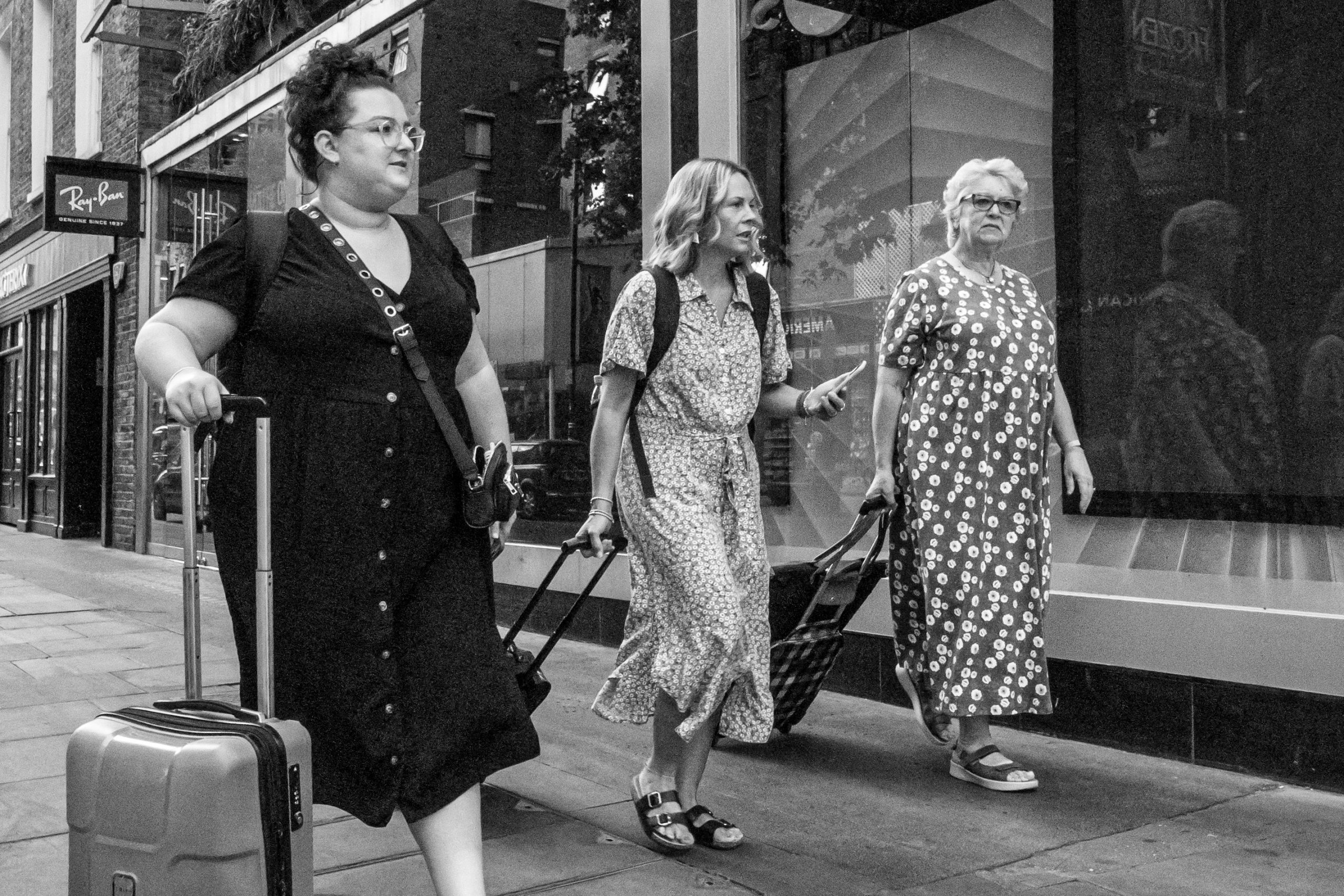
I spent a morning in London getting to know the X100V a little better—this is the first time I’ve managed to use it properly for street photography.
I decided to keep things simple by shooting exclusively in black and white, using high contrast with the intention of blowing the highlights to try and focus attention on the subjects as much as possible. Given that it was a bright day, this made exposure a delicate process so I figured I’d go the whole hog and switch raw files off so that I had practically no latitude.
I started out with auto ISO and shutter speed, using the exposure compensation dial to control exposure, but after a while I concluded that (especially in such contrasty light) the quickest and most effective way of working was to select ISO 1600 and a shutter speed of around 1/1000sec, and to use the aperture ring to control exposure. This ability to control the exposure triangle in the traditional manner is one of the key things that makes Fuji cameras so good for this kind of application.
I came across a couple of usability niggles with the X100V. For instance, I would particularly love to be able to set a fixed focal distance for street, as the fly-by-wire focus ring has far too little resistance for my taste and is constantly knocked out of place. But at least the X100V’s autofocus performs well enough—a big improvement over the X100T I had previously. Overall it’s a near-perfect tool for the job, and it was a pretty productive morning.
All images are out-of-camera JPEGs using Acros, with the tone curve and the clarity setting mostly maxed out. A few are cropped slightly and a couple needed a shadow boost, but by and large the whole set required no work in Lightroom.


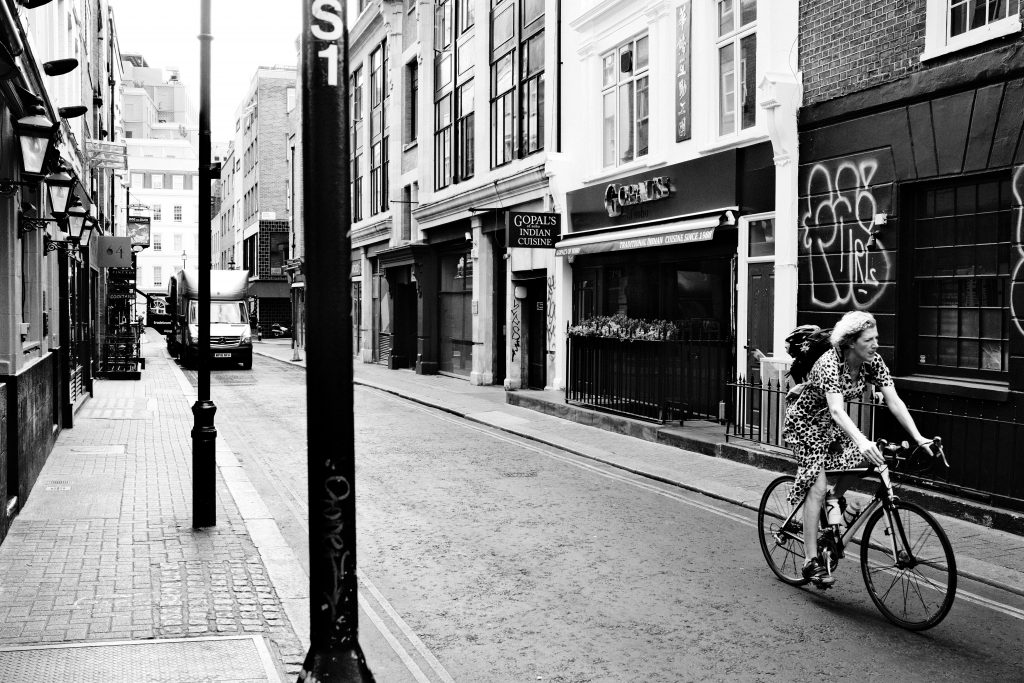


I’ve always been a slightly frustrated street photographer in that I love the genre, but I lack the assertiveness to overtly shoot people. I resolved to finally start making progress in overcoming that, and I did—whilst still managing to recognise the one time that someone was uncomfortable with it. (This image wasn’t that time, of course.)


I used the TCL-X100 II teleconverter for a small number of shots. I like it, but for street purposes the digital teleconverter (or even sports finder mode) is adequate—there’s less need for shallow depth of field and besides, the physical teleconverter’s size makes the camera rather more imposing. Also, frankly, screw threads are a pain.


This guy arrived via the classic “frame the shot, wait for someone to walk into it” approach, but after I took the shot he gave a big grin and a wave and I think he’d have been quite happy for me to stick the camera right in his face. Nice one, random guy.


It was 7:15am when I stepped off the train in the morning, and that’s a great time to arrive because the busy streets are quiet, and as London gets busier you can then move to the back streets. Once the city’s in full swing, the busy areas are hard work for photography because there are simply too many people. This shot, near Gabriel’s Wharf on the south bank, took a couple of minutes of standing and waiting before the gap between the trees contained only the two people on the bench.

When I set out, I had intended to experiment a lot with the X100V’s multiple exposure mode, but here I encountered a small frustration: switching to that mode requires me to remove the camera from my face to press the drive mode button (which is right next to the viewfinder), put it back to my face to navigate down a lengthy menu (I have the rear screen disabled as I don’t use it for shooting, but Fuji haven’t figured out that it would be incredibly useful to revert to the eye sensor for menus so that they can be used on whichever display you’re looking at) and then select the mode; then repeat the process to get back to single exposure mode. An utterly tedious process which absolutely discourages me from using the feature at all.
So I shot a bunch of reflections instead.
Fuji, please allow multiple exposure mode to be assignable to a function button… (not to mention a bunch of other things, such as the digital teleconverter.)


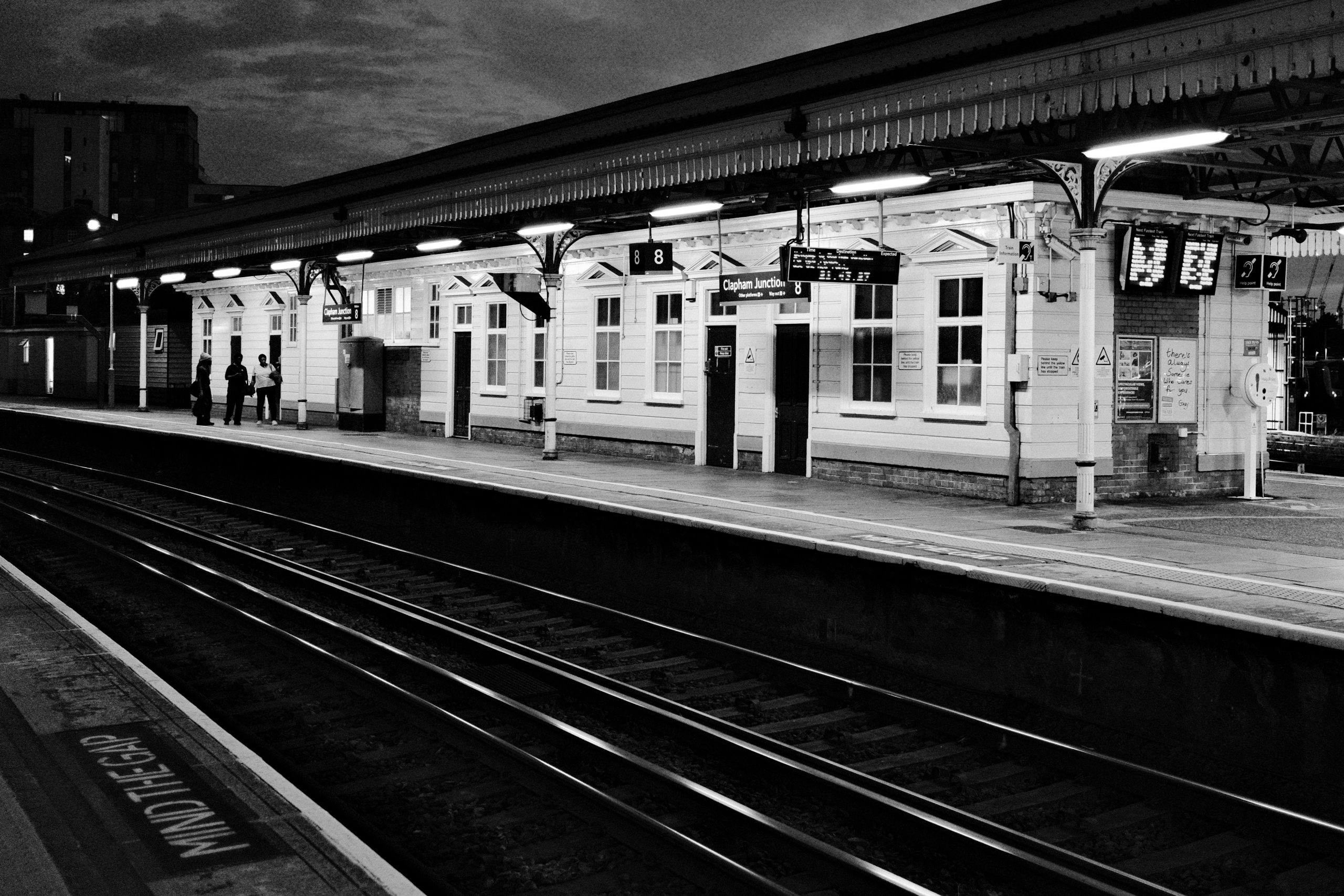

I also shot a handful of images with the venerable Ricoh GR Digital II (the 10Mpx, 1/1.1.7” sensor model that I’ve owned since 2008). Ordinarily I’d use the XF10 for hip shots like these, but I just fancied a blast from the past…