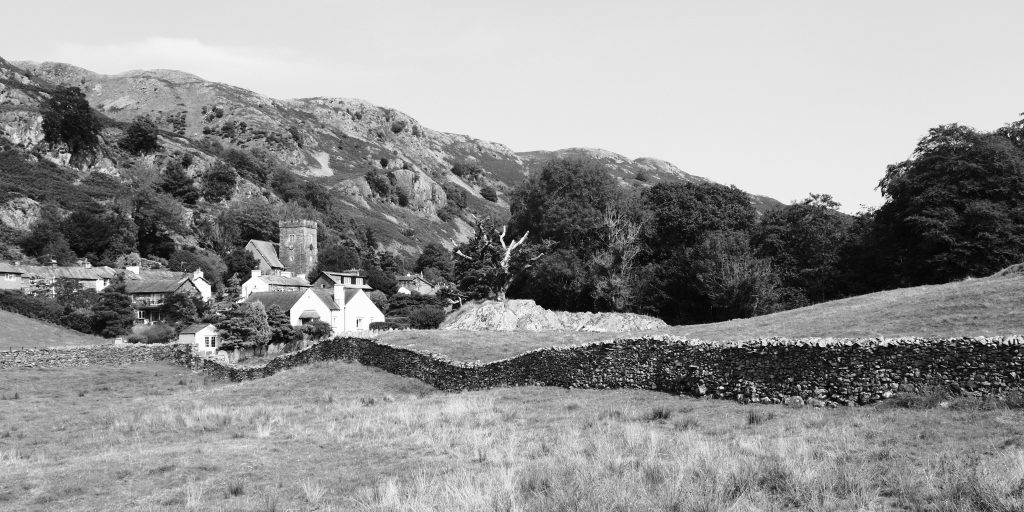
Family holidays. They’re great, but they can be a bit of a challenge when it comes to photography. Not least because they tend to happen in August, when the sky is often clear and undramatic, but also because you’re out in the middle of the day, when the light is either vertical or diffuse. Throw in the limited vantage points afforded by hiking with kids, and a set of locations that we largely visited last year, and the goal of a great landscape shot seems rather unattainable.
So, a change of tack is required to breathe some life into proceedings. Maybe there was a way to take the seemingly hopeless midday summer light and make it work to some sort of advantage.
A blank sheet of paper
Many years ago it occurred to me that while most forms of art are about what you choose to put in, photography is really about what you choose to remove. (I’ve since learned that I’m far from the first person to observe that, and that at least one famous photographer is credited with a quote to that effect, which denies me any pleasure in having personally made the observation but at least backs it up.)
So, in trying to recycle views of The Lakes, my thought was to see if I could go so far with taking things out of the image that it might actually look as if I’d started with a blank page and then chosen what to put in.
Many years ago I used to do a fair amount of pencil sketches and, while I’m not one for trying to make an image made in one medium actually look like it was made in another, it seemed that the general feel of a pencil sketch might be achievable without the need for any tacky Photoshop horrors. In fact, I was hoping to avoid needing even the sliders in Lightroom: I wanted to do it all straight out of camera.
We stopped at Tarn Hows when we arrived. It’s not a location I actually like, but we had a couple of hours to kill before we could get into the cottage, and after six hours in the car we mostly just wanted to sit by a lake.
So here we were, in a location that I find photographically uninspiring, with a featureless sky and vertical light. Time to start finding that blank sheet of paper.

As a first attempt, I was fairly satisfied. Compositionally it’s pretty uninspiring, but it seemed to hit the “sketch on paper” vibe about as well as I had hoped.
On, then, to more of the same…

There was plenty of haze in the air, with thunderstorms looming. Haze can ruin a conventional landscape shot, but it happens to work brilliantly for either reducing distant hills to lighter tones or eliminating them completely. Either way, it can be used to advantage with this style.


Conventional advice, of course, is to expose for the highlights and then boost the shadows. This approach throws that advice out of the window and says expose for the shadows and, broadly speaking, blow as much of the highlights as you can.


You may notice that a few patterns emerge in the images.
One is a composition that places detail and contrast at the bottom edge of the frame. Inevitably, closer subjects produce greater contrast, so there’s a need to avoid too much foreground detracting from the main subject (remember, this is about thinking in terms of drawing things on a blank sheet, and the choices you’d make in doing so: you can choose to de-emphasise foreground with lighter pencil strokes, but you can’t easily do anything similar with a photograph). At the same time, the bright August sky is well-suited to being exposed to the point of being white, and creating that blank page.
Another is that clusters of trees in fields or lakes make good subjects: they create an area of shadow which allows their surroundings to be overexposed again to the point of providing that blank background.

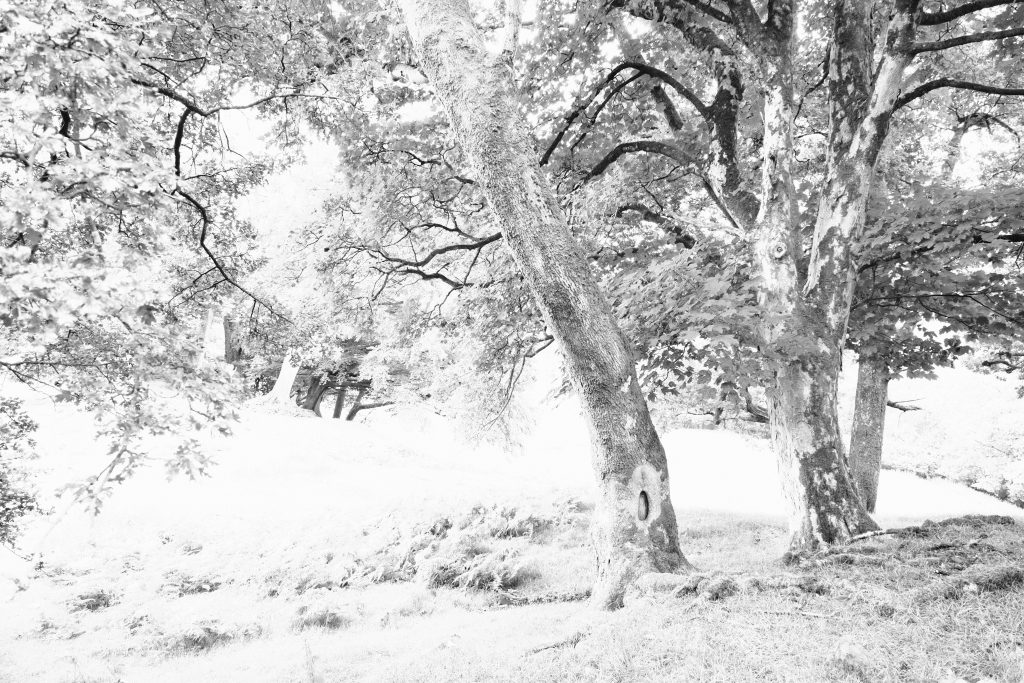
Abstracts are of course possible, but somehow rather less satisfying.

If you drop the exposure just a third of a stop or so, the feel starts to move out of pencil and into ink…


If you want to give it a go, I recommend the following, assuming you’re using a Fujifilm camera with traditional controls.
First, set the camera to use Acros (these were all shot on an X-Pro2 with mostly the XF 16-80) and set both highlights and shadows to +4. If you’ve got an X-Trans IV camera then I’d probably try clarity on +5 as well. Use DR 100%, no grain effect, and whatever sharpening you fancy.
Then I would advise using fully manual exposure. Set a fixed ISO (try a higher one than you would normally use for similar lighting conditions) and use the shutter speed dial and aperture ring to control exposure. With this much contrast in the settings, and in full daylight, exposure will be on a knife edge so you’ll need 1/3-stop adjustments either by using the aperture ring or by using a control dial to fine-tune the shutter speed (personally I don’t like the latter, I turn that feature off, but whatever floats your boat).
Then just blow the highlights away and leave just enough shadow to replicate the level of detail and tone you’d create with a pencil.
Impressionism
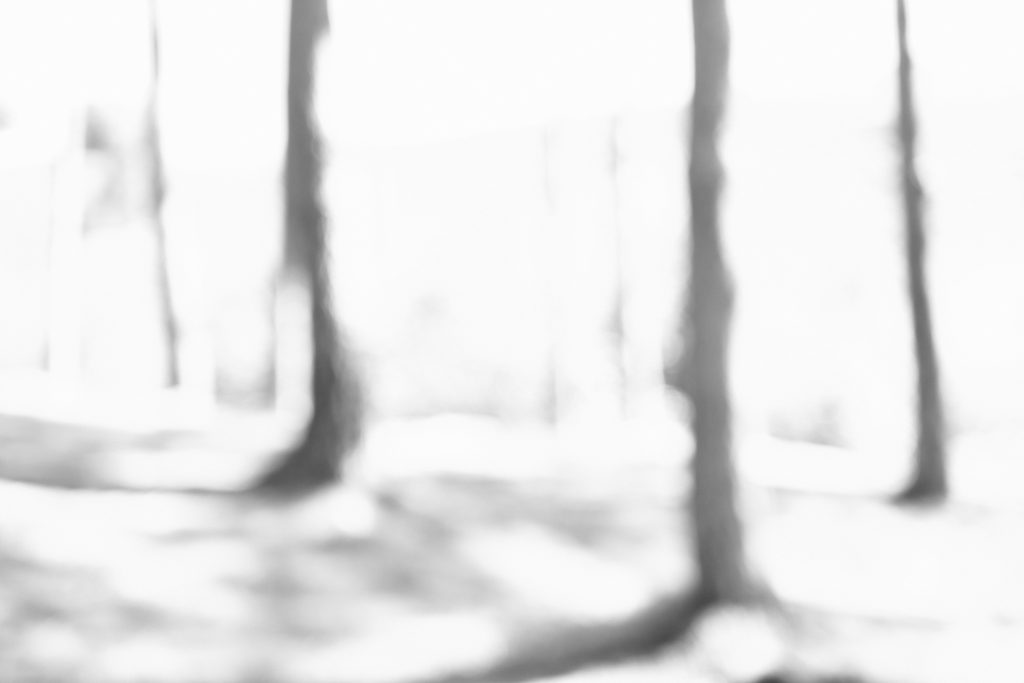
Back to Tarn Hows on that first day, and the sketch style wasn’t enough to keep me occupied, On the southern bank of the tarn is a group of tall conifers, which—like much of Tarn Hows—feel like they should be more photographically helpful than they turn out to be.
However, the tall, straight trunks in the bright light do cast some strong shadows. I took one shot and didn’t like it at all, so again I thought something different was required.
In this case, the something different was to go to manual focus and exploit the not-exactly-legendary bokeh of the XF 27/2.8. Doing so eliminated the distraction from the texture of the grass and the bark, and left just the shadows across the uneven ground and on the trunks themselves.




Randoms
And them, of course, there’s everything else. Still using the same settings in the camera, but less focused on that notion of adding to a blank sheet of paper—and in a number of cases with some tone adjustments in Lightroom, mostly just to blow the shadows.