
Over the last year there’s one use case that I’ve tried to approach in multiple ways in terms of equipment, and that’s a hiking setup.
The requirements are quite particular. Firstly I need to be able to carry it in all weathers, and ideally use it in pretty much all weathers too, which means investing in weather-resistant kit. Secondly it needs to cater for both wide-angle and tele shots, which means multiple lenses and/or a zoom (I’m normally a prime user). And finally it needs to conform to my usual criteria: not too big, and not too expensive.
For the most part, the key element in the solution has been the XF 16-80 f/4 lens. It’s a compromise, but an exceptionally good one: it goes just wide enough and just long enough; it’s fast enough to manage occasional portraits; it has great stabilisation; it’s sharp enough for what I want; it’s weather resistant; it’s not ridiculously large; and while it’s more expensive than I’d normally like, its mix of talents justifies the price.
I’ve used it with a couple of bodies, but mostly an X-T2, which complements it perfectly. However, I’ve recently accepted that the ergonomics of the X-T series don’t really work for me, and I much prefer the form of the X-E/X-Pro/X100 lines. So on this occasion, I rented an X-Pro3 to test it out on a couple of days in the hills.
Day 1: waterfalls
In the valleys between Pontneddfechan and Ystradfellte there are many waterfalls, and the area offers some outstanding walks as well as caving and other more adventurous activities.
With plenty of fast-flowing water around, the stabilisation of the 16-80 comes into play: it’s possible to shoot down to 1/4sec and still get a high proportion of sharp shots.

The pièce de résistance of our usual route is Sgwd yr Eira (below). Ignore the new signs which have been erected, inviting you to turn around and rejoin the Four Waterfalls route. Instead, bring your waterproofs (as if you’d come to Wales without them) because the path goes behind this one.

At this time of year the falling water can be heard long before you see it, and even on approach there’s plenty of spray: you can just make out the droplets forming on the lens in the image above.
Behind the cascade itself, it’s wet enough to be Olympus Tough territory.

This brings us to another piece of hiking kit: the bags that the actual cameras are carried in. A persistent mix of high wind and rain—or the sodden turbulent air behind a waterfall—is an unfriendly combination for even “weather resistant” electronics.
Enter the Alpkit Airlok Xtra 3L. A proper dry bag, but with four attachment points (two on the sides, one on the bottom, and a D-ring one one of the clips at the top). By adding a shoulder strap, you have a bag which is extremely light and easy to carry, but also waterproof to the point of being submersible.

The X-Pro3 and 16-80 just fit (albeit with a Haoge square hood rather than the original petal hood) without restricting the closure from being rolled three times to seal it.
Given that the 16-80 is my largest lens, this means any of my kit will fit in these bags. They’re not padded, but that keeps them light and easy to carry. So far they seem ideal, and a significant improvement over the LowePro toploader I was using previously.
On the way back to the hostel, the low evening sun and the clouds came together to pepper the landscape with light, and with snow on the western slope of Corn Du the long end of the 16-80 came into play—as did the stabilisation, since the wind was so cold that my hands were shivering a fair bit.

Day 2: hills
We’d been half hoping for the flurries of snow to continue into the second day (only half because dragging an 8 year old and a 12 year old up onto exposed areas in freezing wind isn’t necessarily a great day out for all the family) but the weather was more clement.
If you ever find yourself ascending the Brecon Beacons, do yourself a favour and start from the north. Don’t be tempted to park near the Storey Arms on the A470 and take the short route up from there. For one thing it’s a wholly uninteresting path built for heavy tourist traffic, and for another it affords the Beacons no sense of scale or majesty. The most imposing views are those of the steep northern slopes, and from this direction the routes can be challenging in certain weathers.
The first image here, showing the view south to Pen y Fan and Corn Du, was not taken with the 16-80 but with the Pergear 10mm f/8 on an X-T1. This cheap little lens may not be the sort of thing you’d find in a commercial landscape photographer’s bag, but I love its characteristics, and I wouldn’t go walking in big country without it.

Of course, the 16-80 can still grab a fairly wide view. This is from the route via Pen Milan, following the westernmost ridge of the Beacons.
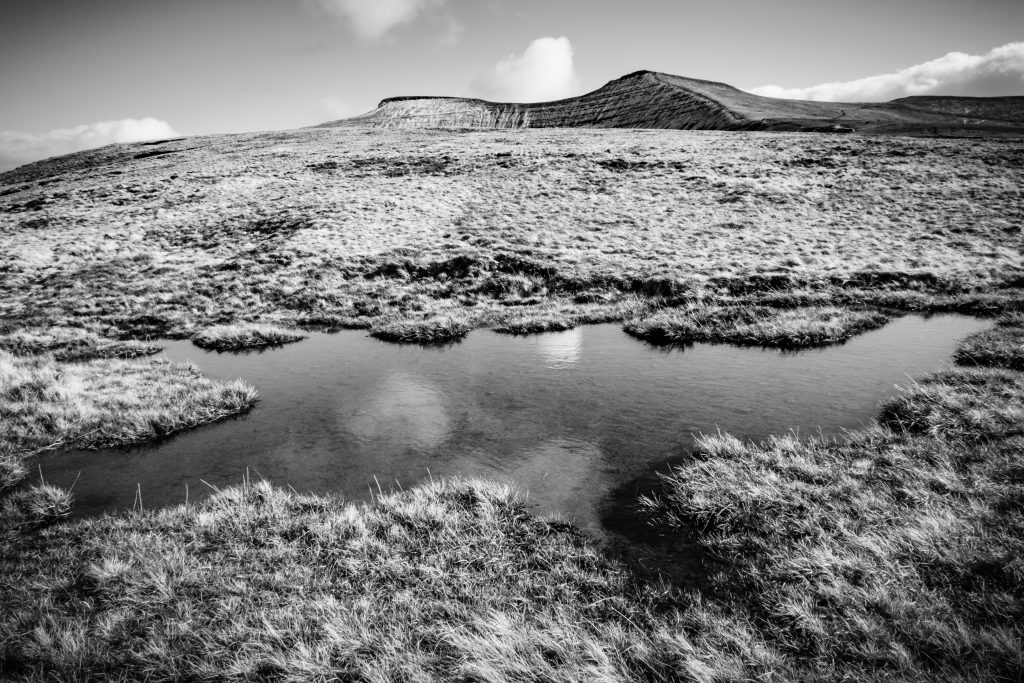
The semi-fisheye 10mm does have a special knack for exploiting the flowing curves of hills, though.

Plus, being so small it’s easy to extract when the kids start throwing snowballs.

Once at the summit, though, the flexibility of the 16-80’s range allows for easy composition given that these aren’t situations where you can “zoom with your feet”. The 80mm long end is just about long enough to capture compressed views across ridges of hills, where the 45/50/55mm ends of Fujifilm’s other wide zooms aren’t—Fuji’s only real alternative here is the 18-135, which sacrifices the wide angle.


And no, not quite every shot ended up in black and white…

Conclusions
So, what of the gear? How does this refine my kit in future?
Well, the X-Pro3 is undoubtedly a great camera, but I personally felt that it offered nothing significant over my X-E3 other than weather resistance. I’m fine with the hidden screen, but the rear submonitor I found to be of no benefit: it just felt like a pointless gimmick. Beyond that I have no complaints about it, I just feel the X-E3 achieves essentially the same things with a smaller (yet no less ergonomic) form and a much lower price tag.
Yet I still have a place for a weather resistant camera with the rangefinder format. And there are only three of those: the X-Pro3, the X-Pro2, and the X100V (all of which I’ve briefly tried, but none of which I currently own).
Of these, the X100V is the most coherent camera to my mind: the fixed lens means no EVF/OVF compromises, and it fits more use cases for me, not least as an all-weather street camera and everyday carry.
So the hiking kit can be honed to the X100V plus the X-E3 with the 16-80. The Alpkit bags means both can be carried even in foul weather, and I’m fine to be constrained to the 23mm lens if I need to shoot in the rain (though the tele converter lens is a tempting addition).
In time, given that the 16-80 will no longer sit on a weather resistant body, and if I decide I can compromise on the long end, I might even trade it for a 16-50—which I’ve previously owned and found to punch well above its weight. Not because the 16-50 is better, of course, but because that swap would release a lot of cash without all that much detriment to image quality.
Also, I still have an XF10 and XQ1 which I use when running and cycling; they may fill the gaps to some extent.
In any case, the bottom line to all of this is something I’ve said before: Fuji simply don’t make any bad kit. You’re kind of spoiled for choice.

Epilogue
In the end, I went somewhat full-circle: the X100V never really felt sturdy enough for a hiking camera and I became frustrated by the X-E3’s handling of ISO in the custom settings, so I went back to the X-T2 with the 16-80 and added the 10-24 and 50-230 for good measure. I’ve also got the option of the Ricoh GR III and the GW-4 wide angle adapter, plus the GR IIIx, if I need to pack ultralight.