
Just for the hell of it, I thought I’d pair the cheapest X body I’ve bought, with the cheapest lens I’ve bought, and take them out on a bike ride to see how they got on.
First, the body. It’s an X-E1 which was on eBay as spares or repair, listed by a reputable camera shop as untested. I’m not sure why they couldn’t muster the resources to pop a battery in and turn it on, but their loss was my gain, and £17.49 later I was popping my own battery in and discovering that it was fine. It was a bit tatty, but with a wipe of some muck and a squirt of some contact cleaner under the power switch to loosen it up, it was all good.
Next up, the lens. A Rockstar 27mm f/2.8, which is a slightly unusual design in that it has variable focus but a fixed aperture. It came boxed and in mint condition for a mere £12.50.
So… £29.99 all in. Can’t be bad!
Now, there is a slight caveat to this, in that I had to donate a battery from my stash, and I’ve not included postage costs. But I’m overlooking that on the basis that I chose not to use the lens that cost me minus £40 (because it came on a camera I bought for £120 and later sold without the lens for £160, which sort of seems like cheating), which would have made for a net cost of almost exactly zero.

First impressions
I won’t turn this into a thorough review of a decade-old camera, though I’ll go into more detail on the lens, but it’s worth shining a light on where they fit in the context of contemporary kit.
The X-E1 is, if like me you enjoy simple shooting, still a highly capable and thoroughly enjoyable camera to use. There are those who to this day rate the X-Trans I sensor (also found in the original X System camera, the X-Pro1, and the X-M1) as producing their favourite colours, and while I’d not call myself a colour connoisseur, I’d happily argue that the sensor’s output doesn’t show its age—I’ve had some extremely impressive results from this sensor.
Sure, the customisation on offer is curiously restricted—only two buttons can be reassigned—but that’s really not too big a problem for casual shooting. Ergonomically the camera is great, and in fact it scores a win in that the info in the viewfinder is much clearer and easier to read than in later models.
As for the lens… well, it’s a similar size to Fujifilm’s own 27mm lens, but that’s where the similarity ends. It’s an utterly simple device, with just a focusing ring that moves the front element. That said, the ring is smooth and well-damped at least.
The body and lens each have one characteristic that contributes to a notable restriction with this setup: the fixed f/2.8 aperture and the maximum shutter speed of 1/4000sec mean that on bright days you’ll be blowing highlights.
(You can fit a 3- or 4-stop ND filter, of course—and indeed I since have—but that’s not really keeping in the spirit of absurd cheapness…)
As you can see from the first shot I took with the combo, below, even early in the morning we’re hitting highlights (I’m sure there’s some leeway in the raw files—these shots are all straight out of camera and in all honesty I can’t recall what settings I was using).
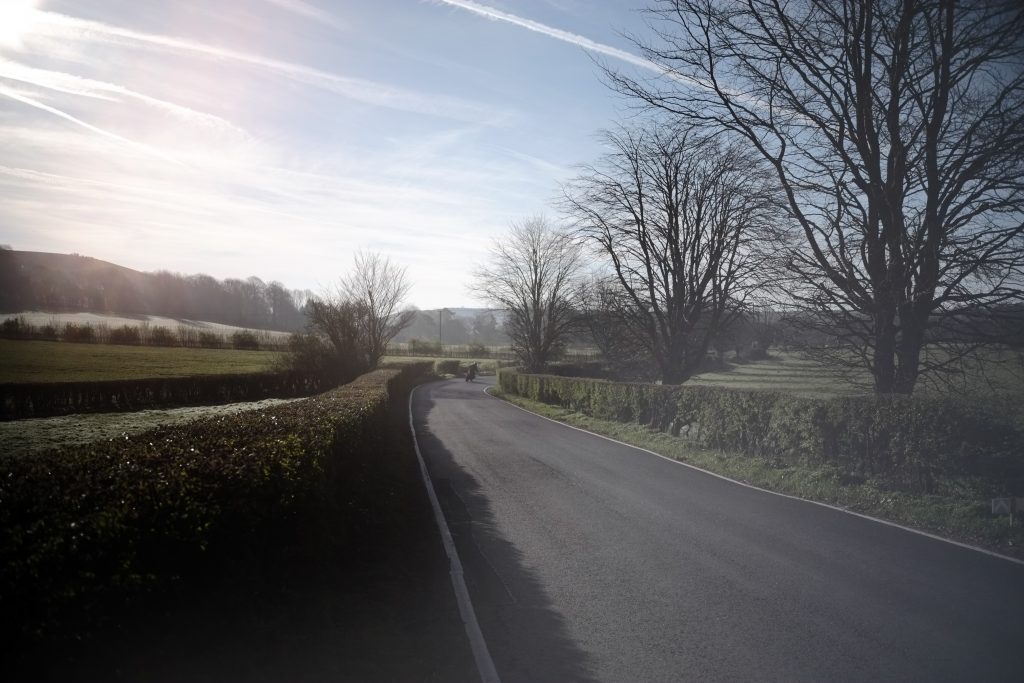
You’ll probably notice some other characteristics of the lens already: firstly that contrast-sapping flare across the image, and secondly the hue shift near the highlights.
However, unlike the Pergear 10mm which turns purple near the corners, this lens leans to amber—which I personally find much more usable—and it seems to be a highlight shift rather than a vignetting shift.

Vignetting is pretty strong, too (the processing here accentuates it somewhat). In fact, in some cases it almost seems that the lens designers were aiming for a Four Thirds sensor, because the corners do sometimes have quite a dramatic localised falloff.
Check the following image, for instance, where there are fairly prominent dark areas in the very corners. You can also see the hue shift coming into play as the unavoidably blown highlights (yup, they’re back) turn amber around the tree branches.
But, you know what? I love this image. It’s like a slide that’s been left on the parcel shelf of a Ford Cortina on a hot day. Technically, it’s awful, but if you were expecting technically competent photos from a £12.50 lens then more fool you. It has a dreamy feel to it, one which you just wouldn’t get from a £500 lens. And that’s ok.

In less challenging light, of course, the lens behaves more conventionally. It’s never pin-sharp, but it’s ok. It has some barrel distortion, so it’s not much of a lens for architecture, but then again, did I mention it was £12.50?


Anyone who remembers the plastic lenses of the very cheapest early 80s point-and-shoot cameras from places like Boots will feel some sort of emotional response to the appallingly washed-out flaring, badly-controlled exposure and colour shifts that this lens serves up on a regular basis.
(The nature of that response, though, will vary wildly: for me, those were formative years, so I have a childish fondness for such flaws, but older or younger photographers may feel less favourably towards them, and no doubt some of the younger ones will just be thinking “so what, there are at least five filters on my Photowank app that’ll do this”—which is great if that’s what you like, but personally I’d rather get immediate results optically than have to faff around with Photowank to get fake results later.)

So to summarise the lens’s qualities: it’s not all that sharp, it has noticeable barrel distortion, it has wild colour shift in the highlights, you can’t even control the highlights, it has pronounced vignetting, and it would seem that the imaging circle doesn’t even cover an APS-C sensor.
As far as lens design goes, it’s an abject failure. Which, because I am clearly some sort of idiot, just endears it to me.
Overall
Let’s face it, this is a ridiculous pairing. If you take a wildly under-engineered lens and mate it with a body that doesn’t let you work around its myriad flaws, surely it’s a recipe for disaster?
Well, yes—if you like technically polished images. But if you like just being forced to look at things differently…? Well, then it’s a recipe for happiness. The fact that the whole setup cost next to nothing only adds to that happiness, and makes it ideal for chucking carelessly into a bag on a bicycle.
More images


